
Trending
The AI Prompt Trend Nobody's Talking About Yet — But Should Be
If you are still buying "10,000 Prompt Bundles" or copying long, complex persona scripts into ChatGPT, you are practicing an outdated art.

Early on, we were told that "Prompt Engineering" was the ultimate future skill. Learn the right phrasing, memorize the right templates, and the AI would hand you gold every time. But as models have grown more powerful, the way they actually process what you type has fundamentally changed — and most of the internet is still teaching you to talk to AI like it's a search engine from 2019.
The real shift happening inside serious AI workflows right now isn't a better prompt. It's a move away from prompts as flat text blocks entirely, toward something closer to architecture: deciding exactly what the model sees, where it sees it, and what you deliberately leave out. Two ideas sit at the center of this shift — Attention Anchoring and Friction-Based Prompting. Neither needs a computer science degree to use. You just need to understand one uncomfortable fact about how these models actually read.
The Mega-Prompt Trap: Why Longer Isn't Smarter
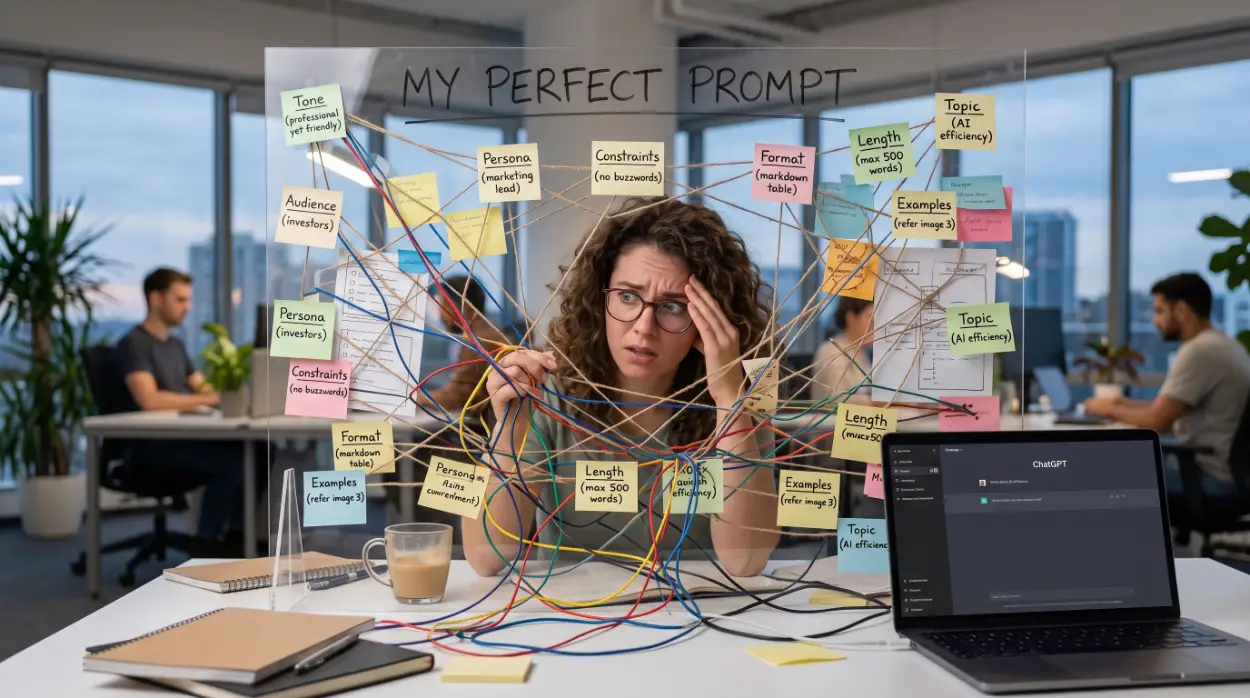
Picture the last "perfect" ChatGPT prompt you built. It probably had five, six, maybe ten instructions stacked in one paragraph — tone, format, persona, constraints, examples, all crammed together because you assumed more detail equals more control.
Here's the problem nobody explains: large language models don't read your prompt the way you read a paragraph. They don't give every sentence equal weight just because it's technically "in the prompt." Research out of Stanford and UC Berkeley — a study that tested exactly this — found that when a model is given a long stretch of information, it reliably performs best on whatever sits at the very beginning or the very end. Instructions buried in the middle get measurably weaker attention, and performance on that middle content drops sharply. Researchers call this a U-shaped curve: strong at the start, strong at the end, a dip everywhere in between.
This isn't a bug that got patched. Follow-up research through 2025 traced it to the actual architecture — the positional encoding and attention mechanisms that decide how much "weight" each part of your input gets are structurally biased toward the edges. It's baked into how the model was built, not something that goes away because you're using a newer version.
So when you write a six-instruction mega-prompt and rule #3 keeps getting ignored — that's not the AI being lazy or "having a bad day." That instruction landed in the model's blind spot.
Why "You Are an Expert Copywriter" Is Quietly Ruining Your Output
Almost every prompting guide online tells you to open with a persona: "You are a world-class marketing expert with 20 years of experience." It feels like it should work — you're giving the AI a role to play.
Here's what actually happens instead: identity priming like this pushes the model toward the safest, most statistically average version of that identity — because "expert copywriter" is a category the model has seen described a million times in training data, and it defaults to the most common, generic pattern associated with that phrase. You're not getting a sharper, more specialized output. You're getting the internet's average idea of what an expert sounds like, which is often the most predictable, least distinctive text the model could produce.
This is the part almost no one talks about: on modern frontier models, elaborate persona preambles move accuracy and quality far less than people assume. They cost you tokens — space that could hold sharper, more specific instructions — for a role-play effect that barely changes the substance of the output.
If personas aren't the lever, what is?
Attention Anchoring: Putting Weight Where the Model Actually Looks

Attention anchoring means working with the U-shaped bias instead of pretending it doesn't exist. Instead of burying your most important instruction in sentence four of a paragraph, you deliberately place it at the two positions the model actually prioritizes: the very start, and the very end.
In practice, this looks like:
Open with the single most important constraint or goal — not a persona, not a warm-up sentence. The first line should be the thing you most need the model to not mess up.
Move supporting detail, background, and examples to the middle. This is where lower-priority information belongs, precisely because the model gives it less weight anyway.
Close by restating the core instruction in different words. This is the "anchor" at the end — a short, direct repeat of what matters most, positioned where the model's attention is strong again.
A simple before-and-after makes this concrete.
Flat mega-prompt (what most people write): "You are an expert content strategist with years of experience in SEO and copywriting. I want you to write a product description for a pair of running shoes. Make sure it's under 100 words, mentions the shoes are lightweight and good for beginners, has a friendly tone, avoids technical jargon, and ends with a call to action."
Attention-anchored version: "Write a product description for running shoes, under 100 words, that a total beginner could read in five seconds and understand.
(Context: these are lightweight beginner running shoes. Friendly tone, no technical jargon.)
Reminder: keep it under 100 words, and end with a short call to action."
Same information. Completely different placement. The anchored version tells the model the non-negotiable constraint (word count, audience, task) twice — first and last — and buries the flexible, "nice to have" descriptive detail in the middle where it belongs.
Friction-Based Prompting: Give the Model a Flaw, Not a Job Title
This is the second half of the trend, and it sounds counterintuitive at first: instead of telling the AI who to be, you tell it what structural constraint to work within.
"You are an expert" is a job title — vague, and the model has millions of generic examples of what that "should" sound like. A structural constraint is something concrete the model has to actively work around, which forces it away from the generic, most-predictable path.
Examples of friction-based instructions:
Instead of "You are a skeptical editor," try: "Every claim in this response needs one sentence of pushback before you accept it."
Instead of "You are a concise writer," try: "No sentence in this response may be longer than 12 words."
Instead of "You are a creative brainstorm partner," try: "None of your first three ideas are allowed to be the obvious answer — actively avoid the most common response."
Notice the pattern — none of these describe an identity. They describe a rule the model has to satisfy while generating text, which forces it away from its default, most statistically likely output. That "friction" is what produces the distinctive, less robotic result people are chasing when they write increasingly desperate persona prompts.
Where This Fits in the Bigger Picture: Context Engineering
If you follow AI news even loosely, you may have noticed a phrase gaining momentum through 2025 and 2026: context engineering. It's being discussed as the discipline that's quietly replacing prompt engineering at the professional level, especially for people building AI agents and complex workflows.
The core idea translates directly to everyday chat use, even if you're not building anything technical: the highest-leverage skill isn't phrasing a clever sentence anymore, it's deciding exactly what information the model sees, and where. Industry discussion around this shift specifically calls out the same failure patterns covered here — identity-priming preambles that barely move accuracy, and "mega-prompts" that stuff in information "just in case," which measurably degrades focus rather than improving it. The technical term some researchers use for this degradation is "context rot" — the more you pile into a single prompt beyond what's actually needed, the less precisely the model uses any of it.
You don't need to be building a RAG pipeline or an AI agent to benefit from this shift. Attention anchoring and friction-based prompting are the same underlying principle — curate what you put in front of the model and where — scaled down to a single ChatGPT, Claude, or Midjourney message.
How to Apply This to Midjourney Prompts Specifically
Image models process prompts differently from chat models, but the "don't dump everything in one flat block" principle still holds — and it maps onto something you've probably already noticed if you generate images regularly: word order changes emphasis. Terms placed earlier in a Midjourney prompt tend to carry more visual weight than terms placed near the end.
Practically, that means:
Put your core subject and most important visual detail first, not buried after five descriptive adjectives.
Save purely stylistic or "nice to have" modifiers for later in the prompt.
Resist the urge to build a 40-word style-stacking prompt just because you've seen others do it — a shorter, front-loaded prompt with a clear priority order will often out-perform a long, flat one.
A Simple Way to Start Anchoring Your Own Prompts
Write your prompt the way you normally would — full mega-prompt included.
Identify the one instruction that matters most — the thing that ruins the output if the model ignores it.
Move that instruction to the very first line, stripped of any persona preamble.
Move all supporting detail, background, and "nice to have" preferences into the middle.
Add a short, differently-worded restatement of the core instruction as your last line.
Wherever you were tempted to write "You are an expert at X," replace it with a structural rule the model has to satisfy instead.
Test this on a prompt you already use often. The difference usually shows up immediately — less generic phrasing, fewer ignored instructions, and outputs that don't read like the model's "safest average guess."
One more thing worth noting: this isn't a one-time fix you apply and forget. As you use a model more, you'll start noticing which specific instructions it tends to drop first — usually formatting rules, word limits, or "don't do X" constraints buried mid-prompt. Once you know your own recurring failure pattern, you can anchor specifically for it, rather than restructuring every single prompt from scratch.
Why This Matters More as Models Keep Getting "Smarter"
There's a common assumption that positional bias is a limitation of older, weaker models — something that will simply disappear as AI gets more advanced. The research so far doesn't support that. Even models with context windows large enough to hold entire books still show the same U-shaped attention pattern when tested on where they place emphasis. A bigger context window means the model can technically hold more information, not that it treats every part of that information with equal weight. If anything, as prompts and conversations get longer — more back-and-forth, more pasted documents, more accumulated instructions — the gap between "technically included" and "actually attended to" grows wider, not narrower. That's exactly why deliberate placement is becoming more relevant over time, not less.
Frequently Asked Questions
Is Attention Anchoring an official technique with a research paper behind it?
Does this apply to short prompts too, or only long ones?
Should I stop using personas in ChatGPT completely?
Does Attention Anchoring work the same way on Claude, ChatGPT, and Gemini?
What's the difference between Attention Anchoring and just writing a shorter prompt?
Is "Context Engineering" only relevant for developers building AI agents?
Why does my AI ignore instructions even when my prompt is well-written?
Can friction-based prompting make responses feel unnatural or robotic?
Does word order matter this much in every AI tool, or mainly text generation?

Promzio Team
AI Prompt Specialists & Curators
Promzio is built and maintained by Jay, a web developer (BCS, MCA) with hands-on experience using AI tools in real projects and workflows. After spending countless hours searching for reliable, ready-to-use AI prompts and facing the same struggles many creators do, Jay set out to build a solution — alongside a dedicated team of 4 — to make that process easier for everyone.
Promzio was created to solve a problem we personally faced: wasting time searching for good prompts instead of creating. Every prompt on this site is tested, organized, and shared with the goal of helping creators, marketers, and AI enthusiasts save time and create better content, faster.