
Guide
The "Negative Prompt Stacking" Trick Almost No One Uses to Fix AI Image Errors
If you've spent more than a week generating AI images, you've probably built yourself a "master" negative prompt. You know the one — a 150-200 word block of everything bad you've ever seen an AI draw, copied from a Reddit thread in 2023 and pasted into every single generation since. blurry, bad quality, lowres, extra limbs, mutated hands, deformed fingers, plastic skin, 3d render, cartoon, anime, text, watermark, signature, ugly, bad anatomy, out of frame, close up, long neck, asymmetric eyes... and on it goes.
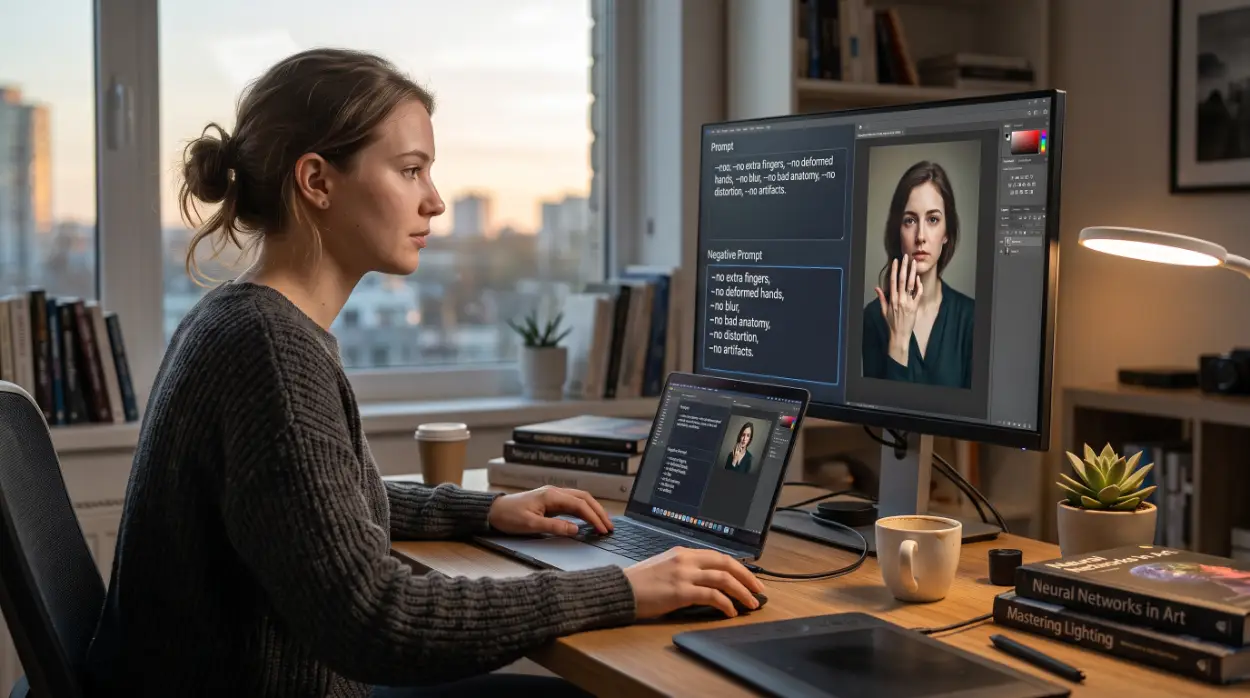
This is the part almost nobody talks about: how you write a negative prompt matters more than how much you write. Dump fifty unrelated concepts into one negative field and you're not giving the model fifty precise instructions — you're giving it noise. The fix isn't a bigger list. It's a smaller, layered, stacked one.
It feels productive. It feels thorough. And it's quietly wrecking your images.
What Negative Prompt Stacking Actually Means

Negative prompt stacking isn't just "adding more negative words." That's the mistake everyone already makes. Real stacking means organizing your negative prompt into categorical layers, each targeting a specific failure point in the image, and weighting each layer according to how badly it's currently breaking your output.
Think of it less like a blacklist and more like a filter system with four passes:
Quality layer — resolution, noise, compression artifacts
Style layer — unwanted rendering styles (3D, cartoon, airbrushed)
Anatomy layer — the structural stuff (hands, limbs, faces)
Cleanliness layer — text, watermarks, signatures, borders
Each layer gets its own weight, applied only as strong as the problem actually is. A mega-block treats "blurry" and "extra finger" with the same urgency. Stacking doesn't — because they're not the same kind of problem, and they don't need the same kind of correction.
Why the Mega-Block Approach Backfires: CFG Burn
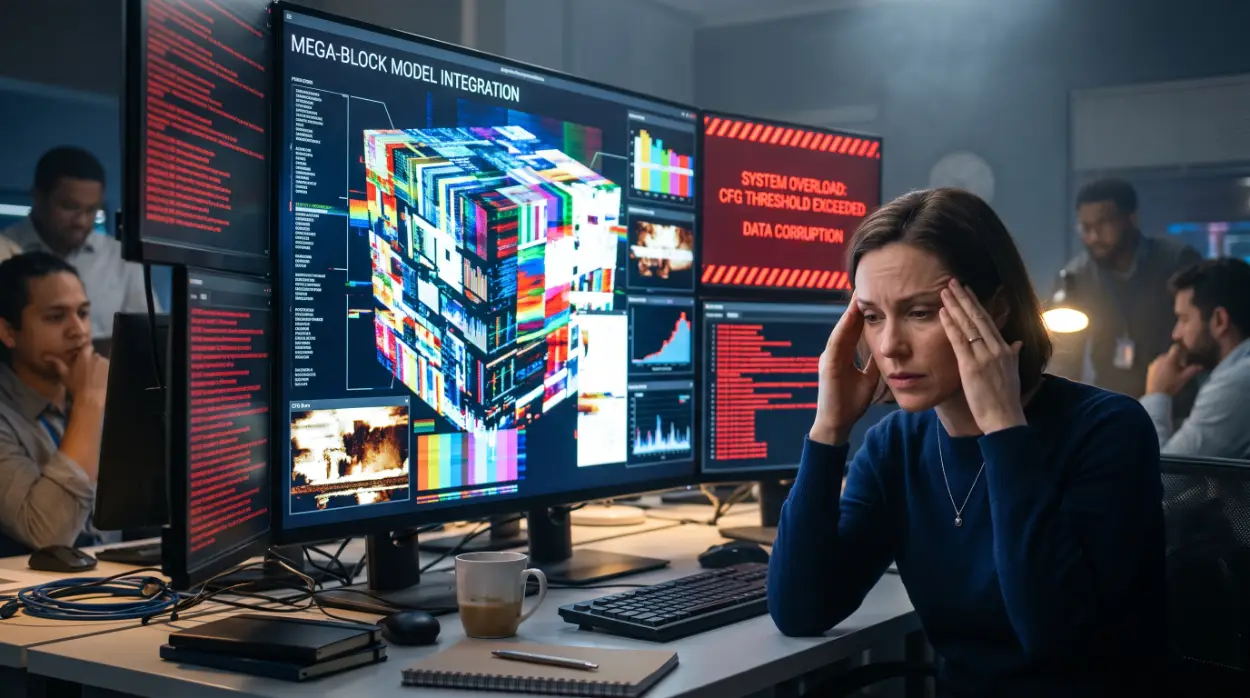
Here's the mechanism most guides skip entirely.
Every time you add a term to your prompt (positive or negative), the model has to account for it during every single denoising step. Classifier-Free Guidance (CFG) — the setting that controls how strictly the model follows your prompt — works by comparing what the model predicts with your prompt against what it predicts without it, then pushing the image further in that direction. The higher your CFG scale, the harder that push.
When your negative prompt is fifty items long, the model isn't gently avoiding fifty things. It's running a much stronger, noisier correction at every step, because it's constantly steering away from a huge cloud of competing concepts. Researchers studying this exact issue have shown that high guidance scales reliably cause oversaturation and artifacts — the image's colors get pushed toward extremes and fine structure starts breaking down. In the community, people call the visible result "CFG burn": overly contrasty, deep-fried looking images with stiff, unnatural poses. Your instinct might be that a longer, more careful negative list should protect you from this. In practice, it's often the direct cause of it, because the correction force compounds with every extra unrelated term you throw in.
There's a second, more mechanical reason mega-blocks fail: the token limit. Models built on CLIP text encoders (this covers most Stable Diffusion 1.5 and SDXL-based tools) process prompts in chunks of 77 tokens. Push your negative prompt past that limit, and depending on your interface, the excess either gets truncated outright or pushed into a second chunk that the model handles with less precision. That "comprehensive" 200-word negative prompt you're proud of? A meaningful chunk of it may not even be influencing your image the way you think it is.
The Categorical Stacking Framework
Instead of one flat list, build four short, targeted layers — and only include a layer if that specific problem is actually showing up in your generations. If your hands are fine, don't weight anatomy terms. If your image already looks accurate, skip the quality layer entirely.
Layer 1 — Quality: targets resolution and rendering noise. Keep it to 2-4 terms.
Layer 2 — Style: removes rendering styles that clash with your intended look (e.g., blocking "3D render" or "airbrushed" when you want photorealism).
Layer 3 — Anatomy: the highest-weight layer, reserved for structural errors — hands, limbs, faces. This is where most of your "problem budget" should go, since anatomy errors are the most visually damaging.
Layer 4 — Cleanliness: text, watermarks, signatures — low weight, since these are usually easy fixes that don't need aggressive correction.
How to Stack Negative Prompts in Stable Diffusion (A1111 / ComfyUI)
Stable Diffusion interfaces support explicit weighting using the (term:weight) syntax — parentheses with a colon and a decimal multiplier. A weight above 1.0 increases emphasis, below 1.0 reduces it. Community testing generally treats 0.7–1.5 as the stable range; push weights toward 1.8–2.0 or higher and you risk the same oversaturation problem described above, because you're essentially applying a mini CFG-burn to that one term.
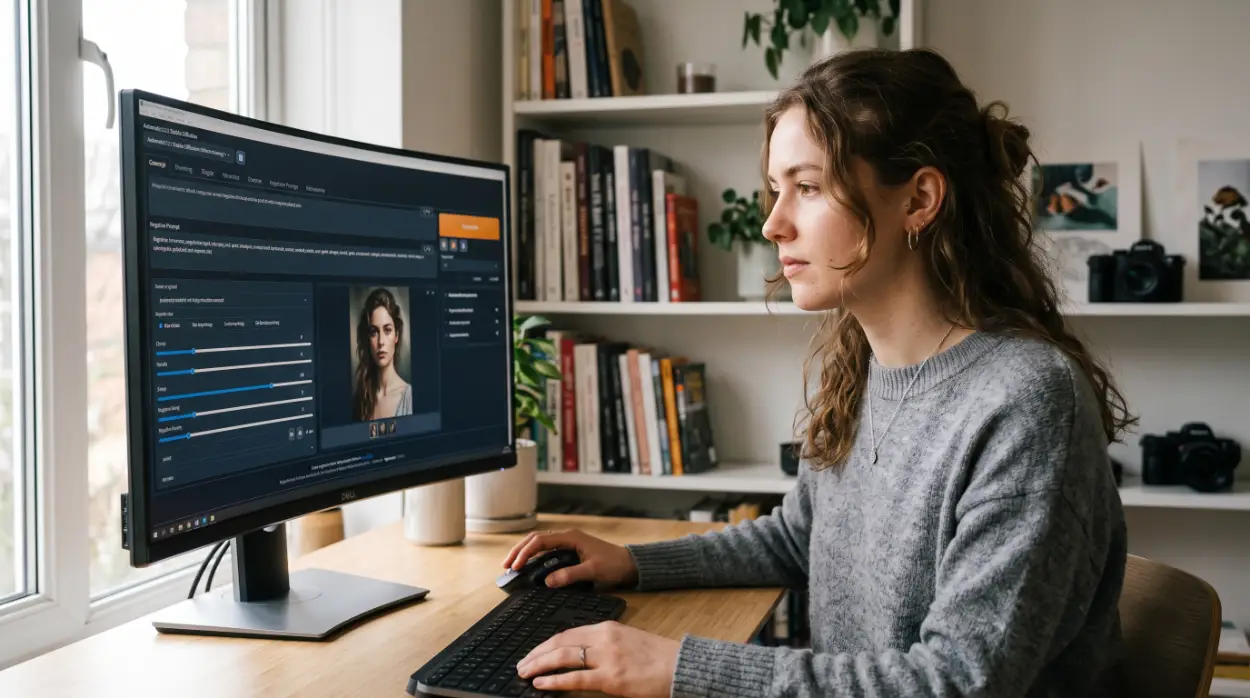
The mega-block approach (what most people do):
Positive: A professional portrait of a female scientist in a lab, cinematic lighting
Negative: blurry, bad quality, lowres, extra limbs, mutated hands, deformed fingers, plastic skin, 3d render, cartoon, anime, text, watermark, signature, ugly, bad anatomy, out of frame, close up, long neck, asymmetric eyes...
Result: harsh contrast, oversaturated skin tones, stiff and lifeless posing — the model is fighting itself the whole way through the generation.
The stacked approach (categorical, weighted):
Positive: A professional portrait of a female scientist in a lab, cinematic lighting
Negative stack: (low quality, blurry, grainy:1.3), [3d render, plastic skin, airbrushed], (mutated hands, extra digits:1.4), [watermark, text]
Notice what's happening here. Quality terms get a moderate weight because they're a real but secondary issue. Style terms use square brackets (a mild de-emphasis, since these are stylistic preferences rather than hard errors). Anatomy — the layer doing the heaviest lifting — gets the strongest weight, because hands are historically where diffusion models struggle most. Watermark and text terms stay unweighted, since they're usually resolved without needing extra force. The model gets a clear priority order instead of one flat wall of "don't."
If you're working in ComfyUI, the same logic applies through its CLIP Text Encode node — just be aware that ComfyUI's default weight interpretation and A1111's don't always match exactly, so if you're porting a prompt between the two, expect to re-tune the weights slightly rather than assuming a 1:1 copy-paste.
How Negative Stacking Works in Midjourney (It's Not the Same Mechanism)

This is where a lot of advice online quietly breaks down — Midjourney does not use the same weighted-bracket system as Stable Diffusion, and pretending it does will cost you a wasted generation.
Midjourney gives you two tools:
The
--noparameter, added at the end of your prompt, listing what you want excluded — e.g.,--no text, watermark, signature. Under the hood, this is functionally identical to giving that item a weight of -0.5 in Midjourney's multi-prompt system.Multi-prompt weighting with
::, where you can manually assign a negative numeric weight to a specific segment, likephoto of a scientist:: extra fingers::-0.5. The one hard rule: the total of all your weights has to stay positive, or Midjourney will reject the prompt.
The "categorical layering" mindset still applies conceptually — group your exclusions by problem type rather than dumping everything into one --no string — but there's an important practical catch specific to Midjourney: its moderation system reads every word inside your --no list independently, not as connected phrases. Something like --no modern clothing can get misread as two separate instructions ("no modern" and "no clothing"), which can even trigger an unintended content flag. The safer version is to keep --no terms short and single-concept, list multiple exclusions with commas, and — if you want to exclude a style rather than an object — describe the style you do want in your main prompt instead of trying to negate it.
So the working stack for the same scientist portrait in Midjourney would look like:
A professional portrait of a female scientist in a lab, cinematic lighting, photorealistic --no text, watermark, signature, illustration
Simpler than the Stable Diffusion version, deliberately — because Midjourney's exclusion system isn't built for heavy multi-tier weighting the way A1111's is.
And Leonardo AI?
Leonardo AI sits closer to the Stable Diffusion side, since several of its models are SD-based under the hood. Its dedicated negative prompt field accepts plain comma-separated terms, and while its interface doesn't expose the same parentheses-weight syntax by default, keeping your list short and categorized still outperforms a long flat block for the same underlying reason: fewer, more targeted terms mean less competing correction pressure during generation.
Common Mistakes That Undo Stacking (Even When You're Doing It Right)
Negating something your positive prompt already implies. If your positive prompt says "forest" and your negative prompt says "trees," you're fighting yourself before the model even starts.
Over-weighting every layer equally. If everything is
:1.4or higher, you've just raised your baseline — nothing stands out as the priority anymore, and you're back to mega-block behavior with extra steps.Using positive phrasing inside a negative field, like "no bad quality." Diffusion models respond to the semantic content of the words themselves, not the grammar around them — write "bad quality," not "no bad quality."
Copy-pasting a photorealistic negative stack onto an anime generation, or vice versa. Quality and style tokens don't transfer cleanly between very different training domains, and can introduce a stylistic drift you didn't ask for.
Weighting obscure or hyper-specific terms the model barely encountered during training. If a term wasn't common in the training data, weighting it harder doesn't make the model understand it better — it mostly just adds noise.
A Simple Way to Build Your Own Stack
Generate a first pass with no negative prompt at all, or a very short one (just "blurry, low quality"). Look at what's actually going wrong.
Sort the errors you see into the four categories — quality, style, anatomy, cleanliness.
Write one short phrase per category, only for the categories that actually have a problem.
Weight anatomy and quality highest if those are your recurring issues; leave cleanliness terms at default weight.
Regenerate, and adjust one layer at a time. Don't rewrite the whole stack after one bad image — isolate which layer needs the change.
This iterative approach also solves a problem mega-block users run into constantly: when a 50-term negative prompt "doesn't work," there's no way to tell which of the fifty terms mattered. With four small layers, you know exactly what to adjust.
Frequently Asked Questions
Is negative prompt stacking the same as "negative embeddings" like EasyNegative?
Does negative prompt stacking work on Flux or other newer models?
Why does my negative prompt seem to do nothing at all?
Can I use negative prompt stacking with LoRAs?
Is there a maximum number of terms I should use per layer?
Why did my Midjourney --no list get flagged when nothing seemed inappropriate?
Does the order of terms inside a negative prompt matter?

Promzio Team
AI Prompt Specialists & Curators
Promzio is built and maintained by Jay, a web developer (BCS, MCA) with hands-on experience using AI tools in real projects and workflows. After spending countless hours searching for reliable, ready-to-use AI prompts and facing the same struggles many creators do, Jay set out to build a solution — alongside a dedicated team of 4 — to make that process easier for everyone.
Promzio was created to solve a problem we personally faced: wasting time searching for good prompts instead of creating. Every prompt on this site is tested, organized, and shared with the goal of helping creators, marketers, and AI enthusiasts save time and create better content, faster.